

We Laughed So We Wouldn’t Burn the House Down
What the women, moms, wives, and girls of the ’70s and ’80s were actually trying to tell us
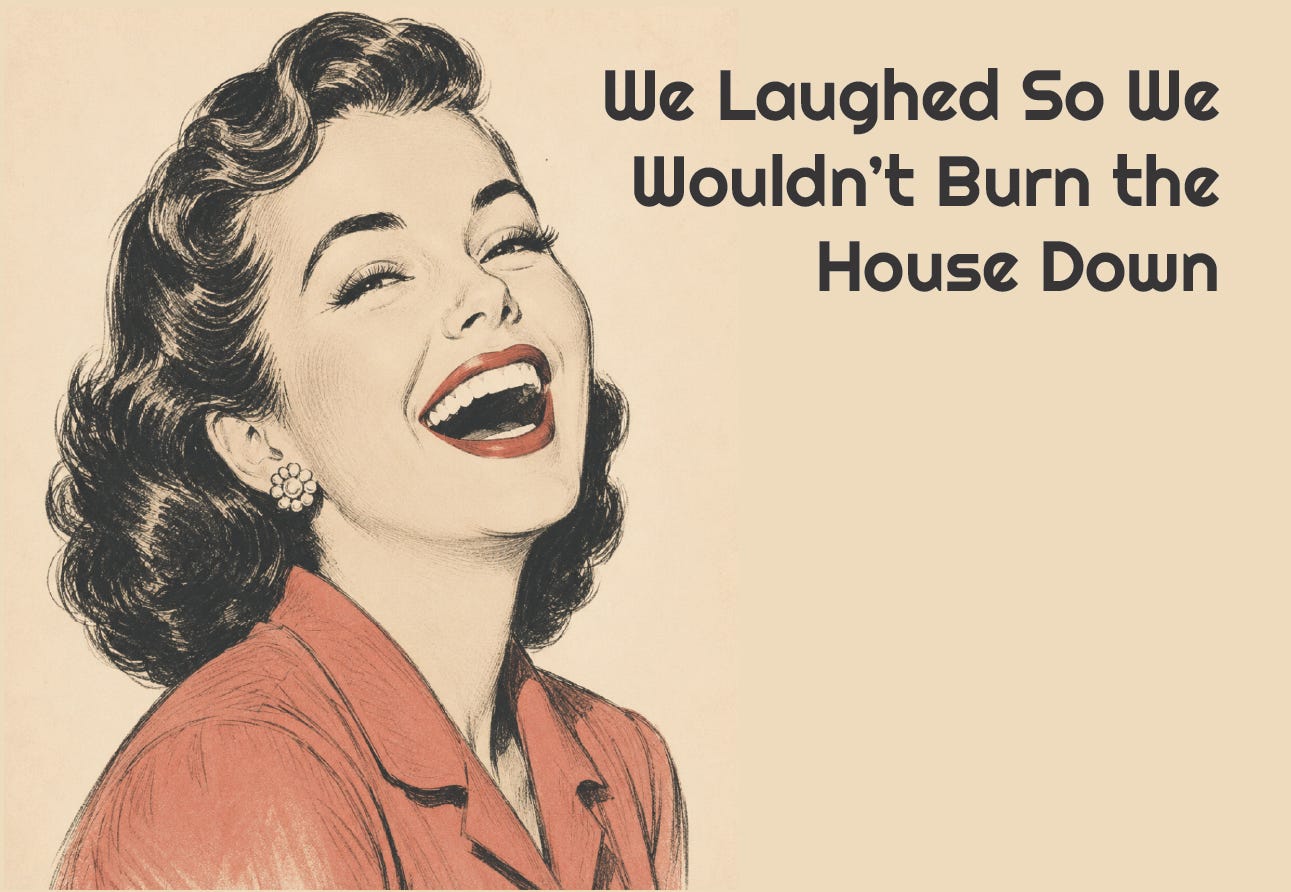
I’ve been thinking a lot lately about the women we grew up around in the ’70s and ’80s and how much of their unhappiness got filtered through humor, cigarettes, Tab cans, ashtrays on kitchen counters, and little muttered comments while scrubbing baked-on lasagna pans after everybody else wandered off to watch TV.
Entire generations of women survived by becoming funny.
And the weird part is: I didn’t fully recognize how much truth was buried underneath all of it until I got older myself.
The more I think about it, the more I realize female humor back then wasn’t really about comedy as much as it was survival. A pressure release valve. A socially acceptable way to tell the truth without blowing up your entire life.
Because women could say almost anything as long as they said it with a laugh. That was the deal.
A woman could joke about wanting to disappear. Joke about motherhood making her insane. Joke about never wanting to have sex again. Joke about carrying the entire household mentally while everybody else sat around asking where things were that had been in the same damn drawer since the Carter administration.
Everybody laughed. Nobody had to look too closely. Life moved on.
And if all else failed? Add a side of forced forgiveness apparently. Your husband emotionally failed you? Here’s a baked pasta dish, no meaningful conversation whatsoever, and instructions to “keep the family together.” A shocking amount of female emotional conditioning from that era basically boiled down to: swallow your rage, freshen your lipstick, and continue serving appetizers.
Women like Erma Bombeck became iconic because she said things women were absolutely thinking but weren’t really allowed to say directly yet. She made domestic life feel honest at a time when culture was still aggressively selling women the fantasy that fulfillment came from marriage, caregiving, and having a spotless house with decorative fruit in a wooden bowl nobody was allowed to eat.
This energy was everywhere.
Carol Brady on The Brady Bunch somehow managing six children, a husband, a housekeeper, perfect hair, and approximately zero visible emotional needs of her own. Janet from Three’s Company permanently stuck playing the responsible adult in the apartment while the men got to be chaotic, unserious, and lovable for it. The women in 9 to 5 fantasizing about kidnapping their misogynistic boss because female workplace rage had to be wrapped in comedy for audiences to tolerate it. And Steel Magnolias (one of my all time fav go-to flicks) may honestly be one of the best examples of this entire dynamic ever put on film: women holding each other together through grief, pressure, caregiving, disappointment, and rage while still being expected to stay charming, funny, composed, and emotionally available right up until somebody finally snaps in public.
The imbalance itself became the joke. Women were expected to laugh at their own depletion before anyone accidentally mistook it for a legitimate problem.
And looking back now through my own midlife eyes, I can see there was something heavier sitting underneath a lot of those jokes that people didn’t fully acknowledge at the time.
I think a lot of women weren’t really kidding. Or at least not fully.
They were lonely. Overwhelmed. Touched out. Sexually disconnected. Emotionally exhausted. Quietly furious. And deeply conditioned to make all of that sound charming instead of alarming.
Because women (especially mothers) have historically had to package pain in ways that didn’t make everybody else uncomfortable.
Rage? Too much.
Resentment? Ungrateful.
Sadness? Self-indulgent.
But make it funny? Suddenly everybody relaxes.
And this is where I think Judy Blume matters as a counterpoint. She was telling girls the truth before they learned how much of themselves the world would eventually ask them to soften, smooth over, downplay, or edit for everybody else’s comfort.
I’m still obsessed with her for that.
Girls in her books were messy. Curious. Weird. Angry. Hormonal. Jealous. Self-conscious. Sexual. Confused. Their inner lives mattered. Their bodies mattered. Their questions mattered.
She treated girls like actual human beings before the world fully did.
Rereading her now (I’ve re-read several of my own personal favs, DM for the list) hits differently because what stands out isn’t innocence. It’s fucking real.
Then somewhere along the way many women learned being fully real came with consequences.
So we got strategic.
We got funny. Capable. Easygoing. “Low maintenance.” We learned how to smooth things over. How to make exhaustion sound relatable. How to tell the truth sideways so nobody would accuse us of being bitter, difficult, dramatic, hormonal, selfish, or “letting ourselves go.”
And I think that’s part of why midlife women sound different right now. Less polished. Less interested in turning every painful thing into a cute little story everybody else can comfortably consume and move on from. Less willing to laugh things off immediately.
The humor is still there (hot take: women remain the funniest people alive by a mile) but there’s more directness underneath it now.
I know I’ve started saying things out loud that younger me would have softened immediately (or just ignored entirely).
Actually, this hurt me.
Actually, I’m angry.
Actually, I’m tired.
Actually, I don’t want to keep white-knuckling my way through life while pretending it’s all so fucking adorable.
Maybe that’s why some people seem uncomfortable with midlife women right now.
I mean, I think I’m still funny as hell.
I’m just not setting myself on fire anymore so everybody else can stay warm and call me “easygoing.”

#RealGirlsGuidetoMidlife #RealGirlsGuide #MidlifeLaughter #70sMoms
We’ve earned every wrinkle. Might as well make more laugh lines together.
Book | Website | Instagram | Facebook | LinkedIn
And if you’ve read the book and loved it, a quick review on Amazon helps keep it moving.
Wow Mama! You have unearthed a mother load. My Mother sang. She sang when she was upset. I mentioned this to my younger sister a few years ago. She immediately realized that I was right yet had never realized. I look back with loving admiration for a mother who was smart, beautiful and put my father on a pedestal yet she was worthy of much more. I so wish I could tell her.
This is fascinating and strikes so many chords. When I look back to my childhood and think of the crap my darling late Mum put up with because it was what she was expected to do. And certain things she would say, that probably came from her mother ( Victorian ladies ) the one that makes me smile and actually is so sad was referring to sex( ew Mum and Dad!) and was to lie back and think of England!
And yes you are very funny!
Mx